I was delighted to be interviewed by Juliet Clark discussing “Turning Your Content into Blooks, Vooks and Slooks.” Listen here. More info on my upcoming 3-part live, virtual course on this. #slook
Being a conscious conversationalist is critical to a long-term relationship, whether with a coworker, customer, or friend—at least for me. I’ve encountered many people who are conversationally challenged. Since it is doubtful your friends or colleagues will volunteer that you are an inept conversationalist, as a public service I thought I’d delineate some of the most common conversational culprits.
I work closely with a tech company which isn’t a client. They have thousands of employees around the world. Their headquarters houses a few thousand.
Because I am a super-user of their site, I get asked to participate in special programs — some beta tests, some educating new, seasoned and prospective users. The few dozen staff with whom I’ve worked are smart.
However, because these intelligent people don’t have a lot of work experience, I find they make decisions that aren’t wise. They don’t think through the repercussions on their users before enacting changes. They don’t decide actions based on long-term ramifications, nor on the message their decision sends about the company’s values.
In my family caustic teasing was de rigueur. We would be teased about anything the teaser thought was funny, no matter how humiliating, and with no thought to how it would leave the receiver feeling. Didn’t do well on a test? You’d be teased about being dumb. Boyfriend broke up with you? He must have finally figured out you are a loser. Lose the student election? They could see you are a follower, not a leader.
The more humiliating the better, from the teaser’s perspective. This wasn’t limited to us kids teasing each other; our parents joined in — or initiated — with glee. The more sensitive the receiver was about the topic, the more the tormentor enjoyed it.
Have you ever teased others about something you knew they were sensitive?
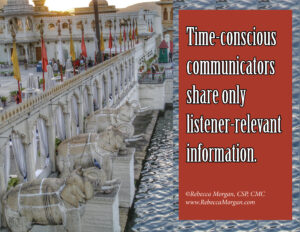
Photo: Rebecca Morgan, The Darikana, Udaipur, India
I’ve noticed a lot of people — maybe 90% — aren’t very conscious of their conversational habits. The most common habit I’ve noticed is no awareness of the relevance of what the speaker is saying to their conversational partner.
I began to wonder how much more productive we would be if we focused our comments on only those of importance to our listeners. Granted, we can’t always know what the other would find important, and sometimes, with close friends and family, we want to share something that is significant to us as a way of sharing ourselves, but may only be interesting to our loved one because they care about us.
In the first chapter of Give and Take, author Adam Grant features Adam Rifkin, who was dubbed Fortune magazine’s Best Networker (he has the most LinkedIn connections to Fortune’s 640 most powerful people). I decided to invite him to connect on LinkedIn.
Wanting to personalize my invitation to increase the likelihood he’d accept, I read his profile. He lives in Silicon Valley, 10 miles from me! He hosts a monthly meet up for start ups. I click on the link and discover the meet up is today in Palo Alto, 20 miles from me. I have the evening open, so I drive to the meet up.
People I admire strive to become better as a partner, parent, child, friend, boss, coworker or human being. They are continually looking for ways to improve, whether for their relationships, or to create more effective habits for themselves.
I’ve noticed three ways these people improve themselves.
Photo: Rebecca Morgan, Chinese New Year lanterns, Hong Kong
Identifying one’s “superpower” has become a hot topic. We are encouraged to identify where we excel. This is not always an easy task. Most of us are either oblivious to how we stand out, or at the other end of the continuum, think have more competence than we actually do.
Thus it’s a challenge to figure out our brilliance. It helps to ask a cross section of friends, peers and your boss or clients to see if a trend appears.
undiplomatic, blunt, condescending, arrogant, caustic, hyper-critical, argumentative (often just for the sake of it, not because they believe their arguments).
So imagine my surprise to be told by a colleague, Peter, that Jim, whom I rarely work with, felt I was difficult.
While I am not fond of feedback from a third-party because specifics are minimal, if any, I take any negative feedback seriously. I use such feedback to explore how much, if any, of the feedback could be truthful, and how I can correct any dysfunctional behaviors.
It left me wondering what “difficult” really means.
The morning was spectacular—a warm Gulf breeze brushed my cheeks. Waves scampered across the beach.
Meditating on the waves’ delicious sound, color and dance, I observed that even as they were approaching the shore, they were retreating.
A small berm lay between me and the surf. A few waves crossed the crest and scurried toward me. But most were spent before reaching the top.
I tried to discern which wave would make it over the top. At first, I thought I could tell by the size of the swell. Surely the largest would make it over. No.
Turning when I heard a loud crash, I thought, “That one will surely make it over.” No.